Is Errors and Omissions Insurance the Same as Professional Indemnity?
Here’s everything a US-based consultant needs to know.
- March 14, 2026
- Insuremia Editorial Team
- Est. Read time 9 min
On This Page
A consultant finishes a project, sends the final invoice, and moves on to the next client until a demand letter arrives alleging that a recommendation caused financial harm. At that moment, the difference between having the right coverage and having the wrong terminology on a policy application can decide whether a claim is paid or denied. One of the most common points of confusion in professional liability insurance is whether Errors and Omissions insurance and Professional Indemnity insurance are two different products or simply two names for the same protection.
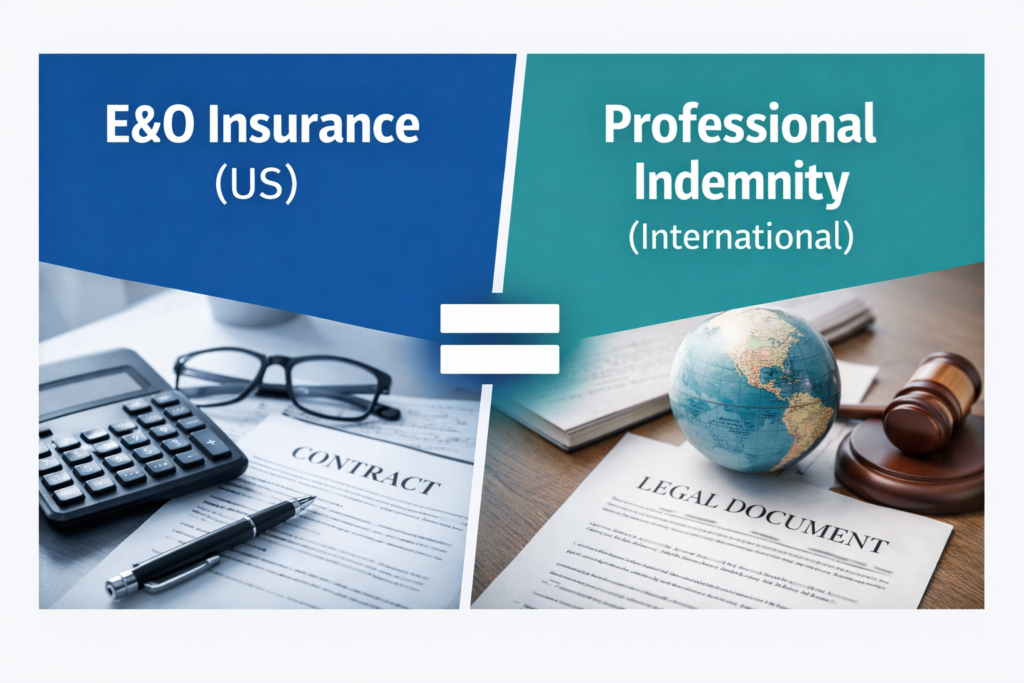
The short answer: in most cases, Errors and Omissions insurance and Professional Indemnity insurance describe the same core coverage but the terminology, policy language, and regulatory expectations shift depending on where you operate.
What is Errors and Omissions Insurance?
Errors and Omissions insurance, commonly shortened to E&O insurance, is a form of professional liability coverage designed to protect businesses and individuals against claims of negligence, mistakes, or failure to perform professional duties. The term is used almost exclusively in the United States and Canada. If a client alleges that a consultant’s advice was inaccurate, that a report contained a material omission, or that a service was performed below the expected standard of care, this coverage responds to the resulting legal defense costs and any settlement or judgment.
Coverage is typically written on a claims-made basis, meaning the policy must be active both when the claim is filed and, in most cases, when the alleged error occurred, subject to a retroactive date. This structure matters significantly for consultants who change insurers or take gaps in coverage, since a lapse can leave prior work unprotected even if the mistake happened years earlier.
What is Professional Indemnity Insurance?
Professional Indemnity insurance often abbreviated as PI insurance is the equivalent product used predominantly in the United Kingdom, Ireland, Australia, and other Commonwealth markets. It provides indemnity protection against financial loss arising from a breach of professional duty, negligent advice, or inadequate performance of contracted services. Functionally, this coverage protects the same exposures as its American counterpart: defense costs, damages, and often costs associated with regulatory investigations tied to a professional’s conduct.
In many Commonwealth jurisdictions, this indemnity protection is not optional. Architects, solicitors, accountants, and financial advisers are frequently required by their regulatory bodies to carry a minimum level of coverage as a condition of practicing.
Key Differences Between E&O and Professional Indemnity
Structurally, the two products are nearly identical, but a few distinctions are worth noting:
|
Factor
|
E&O Insurance
|
Professional Indemnity
|
|---|---|---|
For a consultant operating across borders advising both US and UK clients, for example understanding these overlapping definitions is essential to avoid coverage gaps. Our detailed comparison, Errors and Omissions (E&O) vs. Malpractice Insurance, explores how these liability categories differ further from malpractice coverage, which is typically reserved for licensed medical and legal professionals rather than general consultants.
Regional Terminology Differences: US vs UK/Commonwealth
The divide is largely linguistic rather than functional. In the US, malpractice insurance is generally reserved for physicians, attorneys, and other licensed professions, while Errors and Omissions insurance covers a broader range of consultants, advisors, and service-based businesses. In the UK and Commonwealth markets, Professional Indemnity insurance is the umbrella term applied across nearly all professional services, including consulting, architecture, engineering, and financial advisory work, without the same sharp separation seen in US usage.
Insurers operating internationally often issue policies that reference both terms explicitly to avoid ambiguity for multinational clients, and it’s increasingly common to see “E&O / Professional Indemnity” listed together on binder documents and certificates of insurance
How Coverage Works: The Claims-Made Basis
Both E&O insurance and Professional Indemnity insurance are almost universally written on a claims-made basis rather than an occurrence basis. This means the policy in force at the time a claim is made not necessarily when the underlying error occurred determines coverage, subject to the policy’s retroactive date. Consultants who cancel or fail to renew coverage should strongly consider purchasing an extended reporting period, sometimes called “tail coverage,” to protect against claims that surface after the policy ends but relate to work performed while it was active.
Cost Factors and Risk Considerations
Premiums for professional liability coverage are influenced by several variables: annual revenue, industry sector, claims history, contract terms with clients, geographic scope of work, and the limits and deductible selected. Consultants working with high-value contracts, regulated industries, or international clients typically face higher premiums due to greater potential claim severity. Reviewing client contracts for indemnification clauses and liability caps before binding coverage can also meaningfully affect both pricing and claim outcomes.
The Broader Liability Framework
Errors and Omissions insurance and its Professional Indemnity counterpart rarely exist in isolation. Most consultants pair this coverage with general liability insurance to address bodily injury and property damage exposures, alongside cyber liability for data-related risks. Understanding how these coverages interact within a complete risk management strategy is critical, which is why our pillar resource, General and Professional Liability for Consultants, lays out the full framework consultants need to evaluate their exposure holistically rather than purchasing policies in isolation.
Strategic Comparison: E&O, Professional Indemnity, and Malpractice
It’s worth revisiting how these terms relate to malpractice insurance, since the three are often used interchangeably by clients and even some brokers despite meaningful distinctions. Malpractice insurance is generally profession-specific and tied to licensing boards, while E&O insurance and Professional Indemnity coverage apply more broadly across consulting and advisory services. For a full breakdown of how these categories diverge in scope, licensing requirements, and claims handling, see our companion analysis, Errors and Omissions (E&O) vs. Malpractice Insurance, which addresses the nuances consultants need before assuming their coverage matches their actual professional risk.
Conclusion
Whether your policy documents say Errors and Omissions insurance, E&O insurance, or Professional Indemnity, the underlying purpose is the same: protecting your practice, your reputation, and your finances against the cost of a professional negligence claim. The terminology may shift depending on geography, but the exposure does not. Waiting until a client dispute surfaces is the most expensive way to discover a gap in coverage.
If you advise clients for a living, now is the time to evaluate your professional liability exposure with a specialist who understands both US and Commonwealth market conventions.
Frequently Asked Questions
No. A single US-issued E&O policy typically covers your work regardless of where your clients are based. What you do need to verify is that your policy's territorial scope includes the countries where your clients can file a claim this is a one-line check with your broker, not a second policy purchase.
Read the clause carefully: if it mentions "professional services," "advice," or "errors" that's E&O/PI territory and your standard consultant policy applies. If it specifically says "medical," "clinical," or "legal malpractice," that's a licensed-profession requirement that doesn't apply to most consultants. When in doubt, send the clause to your broker reviewing contract insurance language is a standard part of their service.
You don't need to and you shouldn't try to alter certificate wording yourself, as that can void your policy. The right move is to ask your broker to issue a revised certificate that references both terms, or adds an explanatory endorsement. Most insurers accommodate this as a routine administrative request at no extra cost. Hand that to your client's procurement team and the issue is resolved.
Disclaimer: This article is provided for informational purposes only and does not constitute legal, regulatory, or professional insurance advice. Consult a licensed insurance broker or qualified legal counsel for guidance specific to your situation.