Is Errors and Omissions (E&O) Insurance the Same as Professional Indemnity?
understand why could save you from signing a contract in a panic. Here’s everything a US-based consultant needs to know.
- March 14, 2026
- Insuremia Editorial Team
- Est. Read time 9 min
On This Page
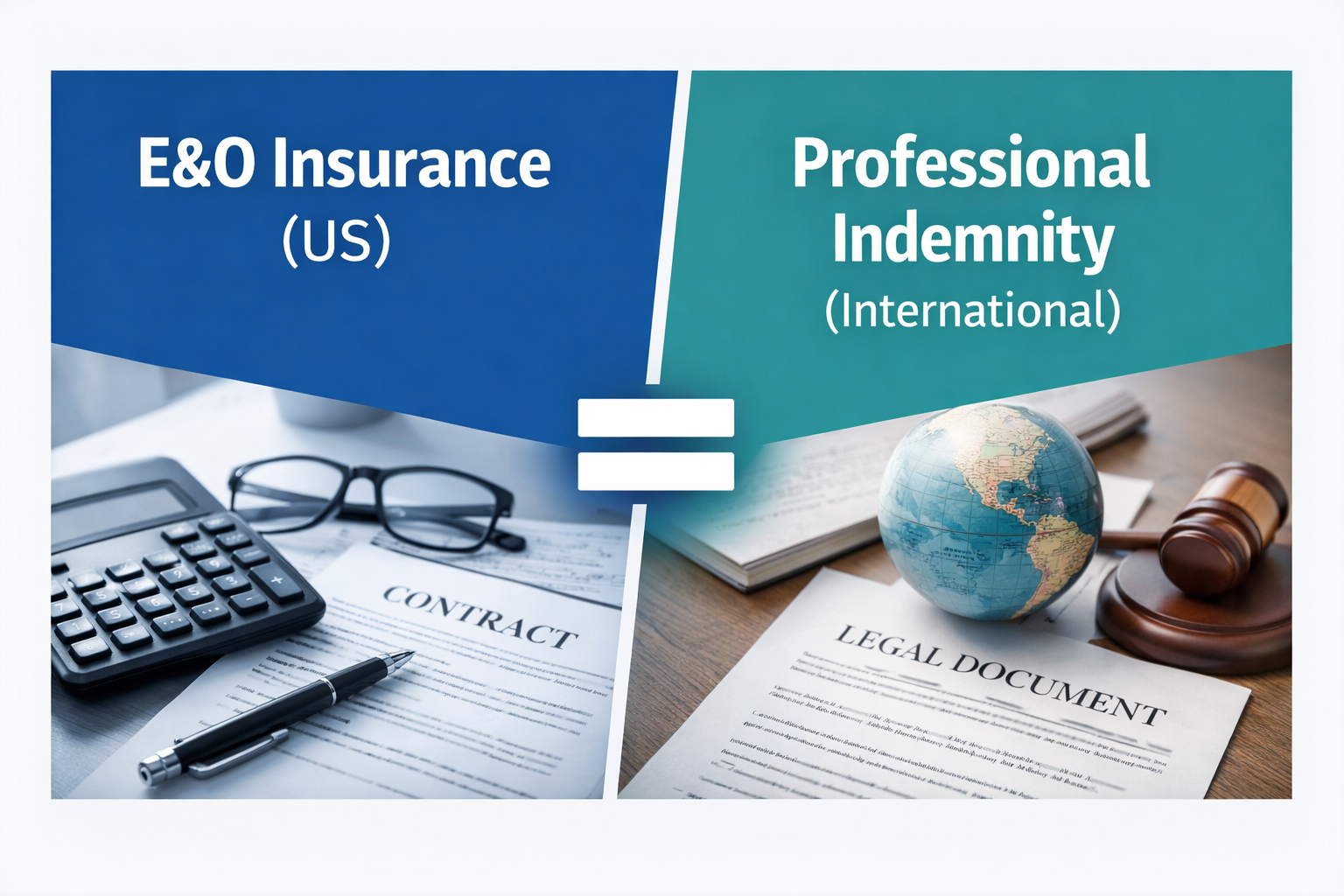 Is errors and omissions insurance the same as professional indemnity? For most US businesses, the answer is yes. Errors and Omissions (E&O) insurance and Professional Indemnity insurance cover the same types of claims and protect against the same professional risks. The difference is largely geographic terminology rather than a change in policy substance.
Bottom Line for US Consultants
E&O Insurance → American term, used by US insurers, in US contracts, and on US certificates of insurance.
Professional Indemnity → British/international term for the exact same coverage.
If a contract asks for PI, your US E&O policy almost certainly satisfies that requirement.
Why Two Names Exist
Both terms describe the same branch of insurance: coverage that protects a professional when a client claims their advice, services, or work product caused a financial loss. The coverage gap that both products fill negligence in professional services is identical regardless of what it’s called on the policy document.
The divergence is purely historical and geographic:
- United States & Canada: The market settled on “Errors and Omissions” a descriptive name highlighting the two main causes of claims (things you did wrong, and things you failed to do).
- United Kingdom, Australia & the EU: The market adopted “Professional Indemnity” language that emphasizes the professional’s duty to make a client whole after a mistake.
- Both markets: Use “Professional Liability” as the overarching regulatory and legal category that houses both terms.
When a global firm, UK-headquartered company, or international NGO sends you a contract with a PI requirement, their legal team is using the language they know. They are not asking for a different or more expansive type of insurance. They are asking for what their home market calls professional liability coverage which is your E&O policy.
The Contract Clause Problem: What to Do When a Client Asks for PI
Here’s a scenario that comes up constantly for US-based independent consultants and agency owners: you land a contract with a global firm maybe a UK-based financial services company or a European tech group and their standard vendor agreement includes a clause like this:
“Supplier shall maintain Professional Indemnity insurance with a minimum limit of $1,000,000 per claim throughout the duration of this Agreement.”
Your first instinct might be to wonder whether your existing E&O policy qualifies. In almost every case, it does. Here’s the framework for confirming that.
Step 1: Understand the Overarching Category
Professional Liability is the umbrella term used in insurance regulation and legal contexts worldwide. E&O and Professional Indemnity are both subsets of this category. When a contract clause specifies PI, it is referencing the professional liability category not a specific product that is unavailable in the US.
Step 2: Check Your Policy’s Declarations Page
Your E&O policy’s declarations page should describe the coverage as “Errors and Omissions,” “Professional Liability,” or both. Some US insurers already use both terms interchangeably on the same document. If your certificate of insurance (COI) uses the phrase “Professional Liability,” it will typically satisfy a PI requirement without any additional explanation needed.
Step 3: Ask Your Broker for Clarifying Language
If the client’s procurement or legal team pushes back on the terminology, your broker can add an endorsement or explanatory note to your certificate of insurance clarifying that your E&O policy is the US-market equivalent of Professional Indemnity coverage. This is a routine request and costs nothing. Most experienced procurement officers at global firms will accept this documentation without issue.
The One Exception: Jurisdiction-Specific Requirements
In rare cases, a contract may require a policy issued in a specific country (e.g., a policy admitted in the UK). This is different from a terminology mismatch, it’s a genuine coverage question. If you’re regularly working with clients in the UK or EU and signing agreements governed by foreign law, discuss cross-border coverage with your broker as part of your broader General and Professional Liability for Consultants strategy.
E&O vs. Professional Indemnity vs. Malpractice: At a Glance
The table below clarifies all three terms. For US consultants, the most important takeaway is in the final row: you need E&O insurance, which satisfies both E&O and PI contract requirements. Malpractice is a separate product for a different professional category entirely.
|
|
E&O Insurance
|
Professional Indemnity
|
Malpractice Insurance
|
|---|---|---|---|
💡 TIP
Malpractice insurance is not a substitute for E&O, and vice versa. If you’re a management consultant, marketing strategist, software developer, or financial advisor, malpractice coverage is not the product you need. For a deeper comparison of these two policy types, see our companion article: E&O vs. Malpractice Insurance, What’s the Difference for US Professionals?

What Your E&O Policy Actually Covers
Whether your insurer calls it “Errors and Omissions” or “Professional Liability,” a standard US policy for consultants typically covers the following scenarios:
- Negligent advice: A client claims your recommendations caused them financial harm — a strategy you recommended led to a loss, or your analysis contained a material error.
- Errors in deliverables: A report, model, code base, or design you delivered contained mistakes that cost the client money to remediate.
- Omissions: You failed to flag a risk, disclose a conflict, or advise on a critical issue that you were professionally expected to address.
- Missed deadlines: A delay in your deliverable caused the client a quantifiable financial loss.
- Defense costs: Even if a claim against you is ultimately unfounded, your policy covers legal defense fees which can be substantial even for meritless suits.
Policy Wording Matters
The coverage above represents a standard policy. Your specific risks the industries you serve, the size of your clients, and the nature of your deliverables determine whether a standard policy is sufficient or whether you need additional endorsements. This is why reviewing your contract requirements with a specialist broker is essential, not optional.
Key Takeaways for US Consultants
- E&O and Professional Indemnity are the same product different regional names for the same professional liability coverage.
- If an international client’s contract asks for PI, your US E&O policy almost always satisfies that requirement.
- The overarching legal category Professional Liability is recognized globally and is the common ground between both terms.
- Ask your broker to add clarifying language to your certificate of insurance if a client’s procurement team questions the terminology.
- Malpractice insurance is not the same as E&O it is a separate product for licensed clinicians and attorneys.
- Cross-border work may require additional policy endorsements for jurisdiction coverage not because of terminology, but because of where claims can be filed.
More in This Series
→ General and Professional Liability for Consultants — The complete guide to policy limits, costs, and coverage types for US consultants
Lorem ipsum dolor sit amet, consectetur adipiscing elit. Ut elit tellus, luctus nec ullamcorper mattis, pulvinar dapibus leo.
Frequently Asked Questions
No. A single US-issued E&O policy typically covers your work regardless of where your clients are based. What you do need to verify is that your policy's territorial scope includes the countries where your clients can file a claim this is a one-line check with your broker, not a second policy purchase.
Read the clause carefully: if it mentions "professional services," "advice," or "errors" that's E&O/PI territory and your standard consultant policy applies. If it specifically says "medical," "clinical," or "legal malpractice," that's a licensed-profession requirement that doesn't apply to most consultants. When in doubt, send the clause to your broker reviewing contract insurance language is a standard part of their service.
You don't need to and you shouldn't try to alter certificate wording yourself, as that can void your policy. The right move is to ask your broker to issue a revised certificate that references both terms, or adds an explanatory endorsement. Most insurers accommodate this as a routine administrative request at no extra cost. Hand that to your client's procurement team and the issue is resolved.