Errors and Omissions (E&O) vs. Professional Indemnity: Is There a Difference?
- March 15, 2026
- By Redouane Khaldi
- Est. Read Time: 12 min
On This Page
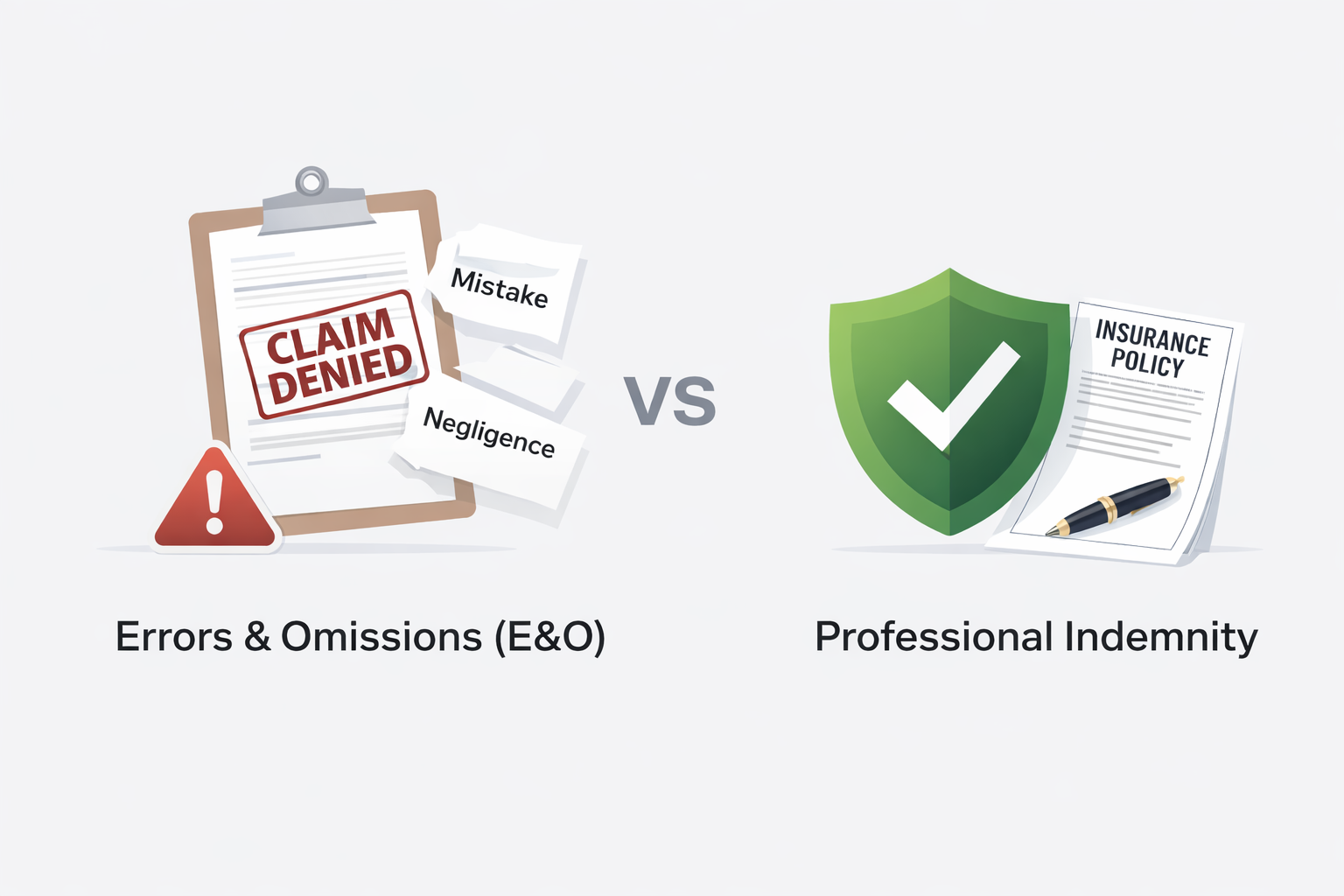
When researching professional liability insurance, the debate of Errors and Omissions vs Professional Indemnity is likely the first hurdle you’ll face. You’ve almost certainly encountered both terms: Errors and Omissions (E&O) insurance and Professional Indemnity (PI) insurance. They appear in different contexts, carry different price tags on comparison sites, and seem to be marketed to different audiences making it completely reasonable to wonder whether you need one, the other, or both.
The short answer: in most situations, E&O and Professional Indemnity are the same product. The difference is largely one of geography, industry convention, and branding, not coverage.
But there are important nuances that can affect exactly what policy you buy and how much protection you carry. This guide cuts through the confusion, explains when the terms diverge, and helps you identify the right coverage for your business.
The Terminology Explained: Why Two Names for the Same Thing?
Geographic Naming Conventions
The insurance industry did not develop in a vacuum, it evolved differently in different markets, and the language stuck.
- In the United States and Canada, professional liability coverage for non-medical service providers is almost universally called Errors and Omissions (E&O) insurance. The name reflects the two most common triggers for a claim: an error you made (doing something wrong) or an omission you committed (failing to do something you should have done).
- In the United Kingdom, Australia, and most of the international market, the same coverage is called Professional Indemnity (PI) insurance. The term ‘indemnity’ reflects the legal principle of restoring a harmed party to their original financial position which is exactly what the policy is designed to accomplish.
- In Europe and parts of Asia, you may encounter the term ‘Professional Liability Insurance,’ which is functionally equivalent to both of the above.
For consultants operating across borders or working with international clients, this is more than a linguistic quirk. When a contract from a UK-based client requires you to carry ‘Professional Indemnity insurance,’ they are asking for the same coverage your US broker would call ‘E&O.’ Understanding this equivalency helps you avoid under-insuring yourself or purchasing duplicate policies.
Industry-Specific Usage
Even within the United States, industry convention shapes which term is used:
- Technology consultants, IT firms, and software developers almost always see the term E&O often bundled with cyber liability.
- Financial advisors, accountants, and investment professionals are typically required to carry E&O insurance by their regulators (FINRA, SEC, state securities boards).
- Management consultants, marketing agencies, and business advisors may encounter either term depending on the insurer.
- Architects and engineers often see ‘Professional Liability’ rather than either E&O or PI, though the coverage structure is the same.
- Healthcare professionals operate under a distinct product — Medical Malpractice — which has key structural differences. See our sister article: E&O vs. Malpractice Insurance for a full breakdown.
E&O vs. Professional Indemnity: Side-by-Side Comparison
Despite the naming differences, E&O and Professional Indemnity policies cover the same core risks. The table below illustrates the key dimensions of each:
|
|
E&O Insurance
|
Professional Indemnity
|
|---|---|---|
|
Where it's used
|
United States & Canada
|
UK, Australia, Europe & globally
|
|
Who needs it
|
Consultants, IT professionals, financial advisors, agencies
|
Consultants, accountants, architects, solicitors
|
|
What it covers
|
Errors, negligent advice, omissions, missed deadlines, flawed deliverables
|
Negligent acts, errors, omissions, breach of professional duty
|
|
Is it the same thing?
|
Yes, functionally identical to PI
|
Yes, functionally identical to E&O
|
Which One Do I Need? A Decision Framework for Consultants
The most practical way to answer this question is not to focus on the label, but on the substance of your work, the jurisdiction of your clients, and the contractual requirements you face.
Step 1: Where Are Your Clients Located?
If the majority of your clients are in the United States, your broker will almost certainly sell you an E&O policy. If you work primarily with UK, Australian, or European companies, the contract language will likely specify Professional Indemnity. In either case, ask your broker to confirm that the policy satisfies the specific contractual language your client is using.
Step 2: What Does Your Contract Say?
Client contracts particularly those from enterprise companies, government agencies, and regulated industries will often specify both the type and the minimum limit of coverage required. Read this language carefully. A contract requiring ‘£1 million in Professional Indemnity insurance’ is not satisfied by a $1 million US E&O policy unless your insurer explicitly confirms the coverage is equivalent and internationally recognized.
Step 3: What Services Do You Provide?
E&O/PI coverage is appropriate for any consultant who provides advice, recommendations, designs, analysis, or professional services that a client relies upon to make decisions. This includes:
- Strategy and management consultants
- IT consultants, software developers, and technology advisors
- Marketing, communications, and creative agencies
- Financial planners, accountants, and tax advisors (non-medical)
- HR consultants, executive coaches, and organizational development professionals
- Engineering, architectural, and technical consultants
- Legal consultants (non-practicing / advisory roles)
Step 4: Do You Also Need General Liability?
Important Distinction: E&O/PI vs. General Liability
- E&O and Professional Indemnity cover the financial harm caused by your professional advice or services. They do not cover bodily injury, property damage, or advertising injury.
- If a client visits your office and trips over a cable, General Liability (GL) covers that claim. If you recommend a flawed IT architecture that results in a data breach, E&O covers that claim.
- Most consultants need both policies. Many insurers offer them as a bundle. See our Pillar Page: General and Professional Liability for Consultants for a full breakdown of how these two coverages work together.
The Cost of Inaction: Why 'I'll Get Coverage When I Need It' Is a Dangerous Strategy
One of the most common mistakes independent consultants make is treating professional liability insurance as optional something to revisit when a major client requires it, or when the practice grows large enough to ‘warrant’ the expense.
This logic is flawed, and the consequences can be practice-ending.
A Single Claim Can Exceed Your Annual Revenue
Common Claims Scenarios for Consultants
The following represent the most frequently litigated E&O and Professional Indemnity claims against consultants and professional service providers:
|
Claim Type
|
What Happened
|
Typical Exposure
|
|---|---|---|
|
Data Error / Analytical Mistake
|
A financial consultant provided forecasts based on incorrect data; client made acquisition decisions that led to losses.
|
$500K–$2M+
|
|
Missed Deadline
|
An IT consultant failed to deliver a system migration on time, causing a client to miss a regulatory filing deadline and face penalties.
|
$100K–$750K
|
|
Incomplete Deliverable
|
A strategy consultant's report omitted a critical risk factor; client suffered financial loss after acting on the incomplete analysis.
|
$200K–$1.5M
|
|
Scope Creep / Miscommunication
|
Client claimed the consultant's recommendations exceeded the agreed scope and created compliance exposure.
|
$50K–$500K
|
The Compounding Effect: Defense Costs Before Settlement
What many consultants fail to factor in is the cost of defense separate from any damages paid to the claimant. In the US, defending a professional liability claim through discovery and trial typically costs between $50,000 and $200,000 in attorney’s fees alone. In the UK, litigation through the High Court can easily exceed £100,000 in legal costs before a judgment is reached.
An E&O or PI policy covers both: the cost to defend the claim and the damages if the claim succeeds (up to your policy limits). Without coverage, both costs are yours to absorb.
Key Policy Features to Look For
Once you’ve established that E&O or Professional Indemnity coverage is right for your practice, the next step is evaluating the policy itself. Here are the features that matter most:
Claims-Made vs. Occurrence Coverage
The overwhelming majority of E&O and PI policies are written on a claims-made basis: the policy in force when the claim is filed not when the incident occurred is the one that responds. This means that if you had coverage in 2022, let it lapse in 2023, and a client files a claim in 2024 for work you did in 2021, you have no coverage.
This makes continuity of coverage critically important. Never allow your E&O/PI policy to lapse without first securing either an extended reporting period (ERP) or confirming that your new policy includes a retroactive date that covers your prior work.
Retroactive Date
The retroactive date is the date from which your current policy will cover past work. If your retroactive date is the same as your policy inception date, you have no coverage for anything that happened before you bought the policy. Work with a broker to negotiate the earliest possible retroactive date ideally going back to the start of your professional practice.
Policy Limits: Per Claim vs. Aggregate
Most policies state two limits: the per-claim limit (maximum payout for any single claim) and the aggregate limit (maximum payout across all claims in the policy period). A $1M/$2M policy pays up to $1 million per individual claim and up to $2 million total across all claims in the year. For consultants working on large engagements, consider whether a $1 million per-claim limit is sufficient given the size of the projects you handle.
Defense Cost Treatment
Some policies include defense costs within the policy limits (eroding coverage), while others cover defense costs in addition to policy limits (non-eroding). Non-eroding defense coverage is preferable, as a lengthy legal dispute won’t chip away at the funds available to pay a settlement or judgment.
Contractual Liability Coverage
If your client contracts include indemnification clauses where you agree to hold the client harmless for certain losses ensure your policy extends to cover contractually assumed liability. Not all standard E&O/PI policies include this automatically.

Industry Spotlight: Who Needs E&O vs. PI, and Why
Technology & IT Consultants
- Primary Coverage: E&O (US) / PI (UK/International)
- Key Risks: System failures, data loss, integration errors, missed go-live dates, security vulnerabilities introduced by recommendations
- Often Paired With: Cyber Liability Insurance
- Contract Requirement: Nearly universal in enterprise IT contracts
Management & Strategy Consultants
- Primary Coverage: E&O (US) / PI (UK/International)
- Key Risks: Flawed strategic advice, competitive analysis errors, financial modeling mistakes, failure to identify regulatory risks
- Often Paired With: General Liability
- Contract Requirement: Common in Fortune 500 and PE-backed company engagements
Financial Advisors & Accountants
- Primary Coverage: E&O (US) often mandated by FINRA, SEC, or state licensing boards
- Key Risks: Investment advice errors, tax preparation mistakes, missed filings, incorrect financial projections
- Often Paired With: Fidelity Bond / Crime Insurance
- Contract Requirement: Regulatory requirement in most jurisdictions
Marketing, Creative & Communications Agencies
- Primary Coverage: E&O (US) / PI (UK)
- Key Risks: Intellectual property infringement, failure to deliver promised campaign results, unauthorized use of licensed content, missed launch deadlines
- Often Paired With: General Liability + Media Liability
- Contract Requirement: Increasingly required by brand clients and holding companies
Getting the Right Coverage: Your Next Steps
Understanding the terminology is the first step. Securing the right policy at the right limits, with the right features is the step that actually protects your practice.
Work With a Specialist Broker
General insurance brokers can place E&O and PI coverage, but a broker who specializes in professional liability for consultants will understand the nuances: claims-made triggers, retroactive dates, contractual liability extensions, and the specific policy language your clients are likely to require. The premium difference between a well-structured policy and a generic one is often minimal; the coverage difference can be significant.
Start With Your Contract Requirements
Gather the last three contracts you signed or the contracts you are currently negotiating and review the insurance requirements section. Note the required type of coverage, minimum limits, and any specific endorsements required (e.g., naming the client as an additional insured). Bring these requirements to your broker as the baseline for your coverage.
Don’t Wait for a Major Client to Ask
By the time a client requires proof of E&O/PI coverage as a condition of engagement, you may be facing a time pressure that leads to a rushed, inadequate policy purchase. Establish your coverage now at a time when you can be thoughtful about limits, retroactive dates, and policy features
Frequently Asked Questions
In most cases, yes. Both products cover claims arising from professional errors, omissions, negligent advice, and failures to deliver professional services as promised. The difference is primarily geographic: E&O is the dominant term in the US and Canada, while PI is standard in the UK, Australia, and internationally. If your client contract specifies Professional Indemnity and you're purchasing in the US, confirm with your broker that the E&O policy satisfies the PI requirement.
Yes. General Liability covers bodily injury, property damage, and advertising injury, it does not cover claims arising from your professional advice, recommendations, or services. If a client sues you because your consulting work caused them financial harm, only E&O (or PI) will respond. Most consultants need both products. [See our Pillar Page: General and Professional Liability for Consultants for a detailed breakdown.
The minimum is typically determined by your client contracts. $1 million per claim / $2 million aggregate is the most common requirement for independent consultants. However, if you work on large projects where the potential financial exposure to a client could exceed $1 million, consider higher limits. A specialist broker can help you calibrate limits based on your engagement size and revenue.
A claims-made policy provides coverage when the claim is filed, not when the alleged incident occurred. This means your coverage must be active at the time a client makes a claim against you. If you cancel or let your policy lapse even years after completing a project you may have no coverage for a claim filed after the cancellation. Always maintain continuous coverage or purchase an extended reporting period endorsement when you stop practicing.
Yes, if your policy includes a retroactive date that covers the period when the work was performed. Most policies include prior acts coverage back to the policy's retroactive date. This is why it's important to establish the earliest possible retroactive date when you first purchase coverage and to maintain it when you switch insurers.